
Core Stability in Cycling: What It Really Means and Why It Matters

Updated: Aug 10

By Robert Brown, APA Sports and Exercise Physiotherapist | Salty Sports Physiotherapy, Kingscliff
"Core stability" is one of those terms you hear constantly in sport and fitness, but it's also one of the most misunderstood. Ask ten people what it means and you'll get ten different answers. So let's clear it up, and more importantly, let's look at what the evidence actually says about core stability in cycling specifically.
What Does "Core Stability" Actually Mean?
I like to define it simply: core stability is the ability of the trunk, lower back, pelvis, and hip regions to efficiently generate and transfer force, and to effectively deal with external loads acting upon the body.
It's not just about having a strong six-pack or being able to hold a plank for three minutes. It's about how well your whole trunk and pelvis system works together to support movement and transfer power, particularly during sport.
Is Core Stability Really That Important for Cyclists?
This is where it gets interesting. On the surface, you might think core stability isn't a big deal for cyclists. After all, the cycling position involves a relatively fixed, supported posture. The pelvis is supported by the saddle and the arms by the handlebars. Cycling is non-weight bearing, and the forces acting on the body are relatively low compared to running or contact sport.
So how important can core stability really be? The answer, as it turns out, is very, but perhaps not for the reasons you'd expect.
What's Actually Happening in Your Core While You Ride
During every pedal stroke, movement coupling occurs through the spine, pelvis, and hips in all three planes of movement, including flexion and extension, lateral flexion, and rotation. This movement is actually necessary for both stability, in terms of managing the forces generated by each leg and balancing left versus right pedal forces, and power production, in terms of transferring force from the upper body to the lower limb.
The problem arises when a cyclist can't control this movement effectively. Poor control of trunk and pelvic movement means forces aren't transferred efficiently, and that's where injury and performance loss begin.
What Does the Research Say?
The evidence on core stability and cycling is genuinely interesting. Here's what we know.
Cyclists who experience lower back pain have been found to have increased lumbo-pelvic flexion and rotation compared to pain-free cyclists. Importantly, an inability to control lower back and pelvis position, particularly lumbar flexion, appears to place undue strain on these structures, contributing to pain and injury.
One particularly interesting finding: cyclists with lower back pain showed greater spinal flexion across all cycling positions, and this posture didn't change from the start to the finish of a ride. In other words, they started in a more flexed position and stayed there, even as pain developed. This points to a positioning error rather than simple core muscle fatigue as the underlying cause.
Research by Abt (2007) investigated the relationship between core stability and cycling mechanics by fatiguing the core muscles of 15 highly trained cyclists, then measuring their movement patterns. Following the core fatiguing workout, movement at both the knee and ankle increased, suggesting that reduced core stability leads to reduced lower limb control during the pedal stroke.
The implication is significant: when your core fatigues, your legs don't track as well, increasing stress on the knee, ankle, and surrounding structures, and potentially contributing to the overuse injuries so common in cyclists.
Why This Matters for Injury Prevention and Performance
The repetitive nature of cycling, with thousands of pedal strokes per ride, means that even small inefficiencies in movement patterns are amplified enormously. Poor core stability can contribute to lower back pain, which is one of the most common complaints in cyclists, knee pain particularly anterior knee pain from poor lower limb tracking, hip and gluteal pain from compensatory muscle overuse, reduced power output because force isn't being transferred efficiently to the pedals, and fatigue because inefficient movement patterns require more energy.
Improving core stability can help address all of these, promoting greater trunk stability, improving force transmission through the pedals, maintaining better cycling posture, and reducing injury risk.
How to Train Your Core for Cycling
The list of core exercises out there is endless, and honestly, not all of them are relevant for cyclists. The key is to choose exercises that specifically challenge trunk, pelvic, and hip control through the ranges and movement patterns you actually use on the bike.
Here are six exercises I regularly use with my cycling patients, from recreational riders to professional cyclists.
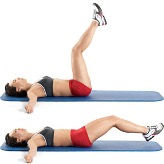
Leg Lowers involve lying on your back with legs raised, then slowly lowering both legs toward the floor while keeping the lower back pressed down. This is excellent for training lower abdominal control and lumbo-pelvic stability.
Dead Bugs with Swiss Ball involve lying on your back and pressing a Swiss ball between your hands and knees. You then slowly extend one arm and the opposite leg while keeping the ball stable. This challenges trunk control through coordinated limb movement and is very relevant to the alternating nature of the pedal stroke.
Mountain Climbers start from a push-up position where you drive alternate knees toward the chest in a controlled manner. This trains trunk stability while the lower limbs are moving, which is directly applicable to cycling.
Back Extensions on a Swiss ball or back extension bench involve controlled spinal extension from a flexed position. This specifically targets the lower back extensors which are working continuously in the cycling position.
Side Planks involve lying on your side supported on one forearm and the side of your foot, then holding a straight body position. This targets lateral trunk stability which is important for controlling side-to-side pelvic movement during the pedal stroke.
Jack Knifes start from a push-up position with feet on a Swiss ball, then draw the knees toward the chest by rolling the ball in. This is excellent for challenging trunk and hip flexor control simultaneously.
How Many and How Often?
Choose 4 to 6 of these exercises and perform them 2 to 3 times per week, ideally on days you're also riding or immediately after. Aim for 2 to 3 sets of each exercise, 8 to 12 repetitions or 20 to 30 seconds for holds, and focus on quality of movement over speed or load.
These don't need to take long. A well-structured 15 to 20 minute core session done consistently will make a noticeable difference over time.

Getting Assessed
If you're dealing with lower back pain, knee pain, or you feel like you're losing power or efficiency on the bike, it's worth getting a proper assessment. Core stability is just one piece of the puzzle. Bike fit, movement patterns, training load, and muscle strength all play a role, and the best results come from identifying your specific weaknesses rather than just following a generic program.
At Salty Sports Physiotherapy in Kingscliff, we work with cyclists at all levels, from weekend riders to competitive road and mountain bike athletes, to assess movement, address the underlying causes of injury, and help you ride stronger and pain free.
Book online at saltysportsphysio.com.au or call 0470 434 340. We're located inside Salt Movement and Recovery, Basement, 2 Bells Blvd, Salt Village, Kingscliff.
References
Abt, J. P., et al. (2007). Relationship between cycling mechanics and core stability. Journal of Strength and Conditioning Research. 21(4), 1300-1304.
Burnett, A., et al. (2004). The relationship between the biomechanical characteristics of cycling and lower back discomfort. Physical Therapy in Sport. 5, 70-75.
Van Hoof, W., et al. (2012). Influence of different racing positions on mechanical load on the lower back in cyclists. Journal of Biomechanics. 45(Suppl. 1), S443.
Salty Sports Physiotherapy is located at Basement, 2 Bells Blvd, Salt Village, Kingscliff NSW 2487. Robert Brown is an APA Sports and Exercise Physiotherapist with over 20 years of elite sport experience including as Head Physiotherapist for the ORICA GreenEdge Pro Cycling Team. Online bookings available at saltysportsphysio.com.au


Comments